
The ‘always-on culture’ of remote working and our ‘novelty seeking brain’ combined with our high workload makes it sometimes hard to truly recover from work. We all stay ‘on’ sometimes when a deadline approaches.There is nothing wrong with that. After all, we all have our own disconnection style. Some of us prefer to work in the evening so we can run errands during the day, while others like to keep a tighter line between work and private life.
But being always connected with work can have a big impact on both our concentration during work and the ability to mentally disconnect from work. From over-stimulation, (techno)stress to even concentration problems or feelings of exhaustion.
That’s why it’s important to approach the impact of workload from multiple angles. In this toolbox, you’ll find various concrete exercises that can help you or the entire team to sustain more energy and to recover more effectively.
Think about your biggest challenge at work and pick the exercise that helps you the most. Good luck!
This is not just a toolbox—it’s an integral part of your larger learning journey. Designed specifically for this trajectory, the toolbox ensures that the insights and exercises introduced during the workshops are seamlessly reinforced and applied in your daily (working) life. With exercises in video format, it enables you to revisit and practice key concepts, making them more than just ideas—they become practical tools you actively use to create lasting change. Each deep dive workshop is further expanded through this toolbox, allowing you to deepen your learning and sustain your growth over time.
Did you miss the kick-off webinar or had to leave earlier? Or maybe you want to zoom in on a tip or trick one more time as a refresh? No worries!
We made a recording of the webinar. You can watch it here.
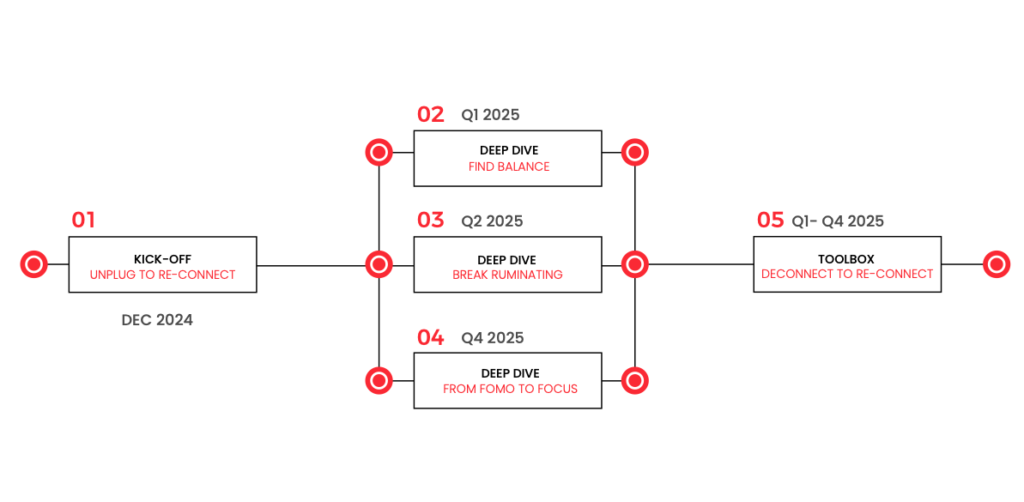
In this toolbox, you will find various concrete exercises that can help you or the entire team to sustain more energy and to recover more effectively!
Depending on whether you want to focus more on reducing techno interruption or if you want to focus on better recovery, you can choose a different exercise.
The exercises in this toolbox can be used individually or as a team to initiate the conversation about disconnection, create good practices and make agreements.
Choose this exercise when you want to increase awareness and knowledge about how demands and resources in work and personal life interact, and to identify steps for creating a healthier balance.
Choose this exercise when you want to increase awareness and knowledge about the impact of insufficient recovery and recognize the individual stress signals associated with it, either individually or together with the team.
Choose this exercise when you want to end your workday without loose ends by creating a set of rituals for yourself that help you transition from the work context to the personal context.
Choose this exercise when you want to critically look at the available communication channels by discussing the purpose and usage of each channel. By doing this, individually or with the team, you can reduce interruptions, increase focus and minimize message overload.
Choose this exercise when you want to create awareness about the different needs in disconnection. By discussing the disconnection styles within the team, you can collectively take these different needs into account.
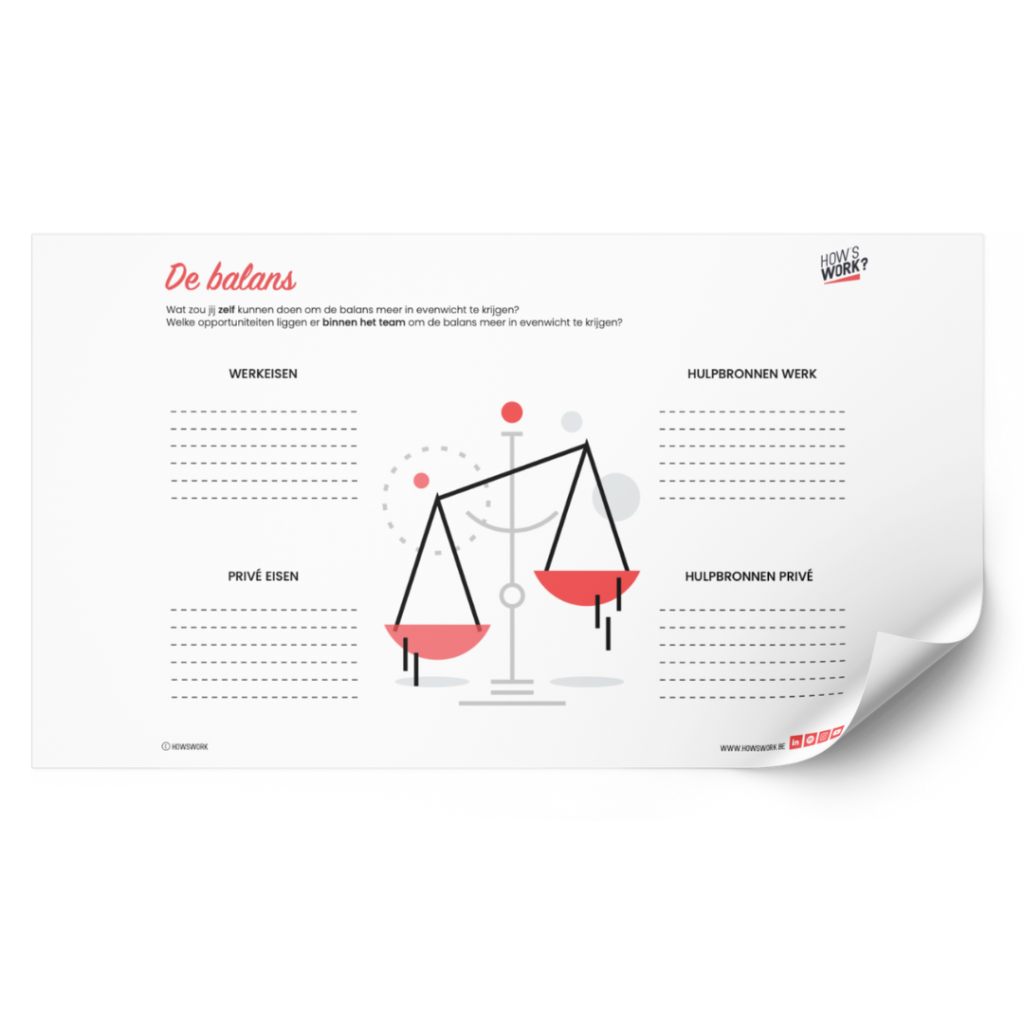
In this exercise, you reflect on the balance between demands and resources in both your work and personal life.
These days, it’s no surprise when the question, “How’s work?” gets the answer, “Busy.” The words “work” and “busy” are often used in the same sentence. But work pressure doesn’t always have to be negative. When job demands and resources are balanced, it can motivate you and give you energy. For example, working on a challenging project with support from your colleagues or enthusiasm for the task can turn challenges into energy and motivation.
However, this balance is fragile. When demands increase without sufficient resources, or when personal challenges arise, the scale tips. Factors like sleepless nights, caregiving responsibilities, or a lack of support at work can disrupt this equilibrium. Similarly, positive experiences, like completing a successful project or quality time with friends, can restore balance and boost energy.
Choose this exercise when you want to increase awareness and knowledge about how demands and resources in work and personal life interact, and to identify steps for creating a healthier balance.
! This exercise can be done individually, during a one-on-one conversation, or together with the whole team
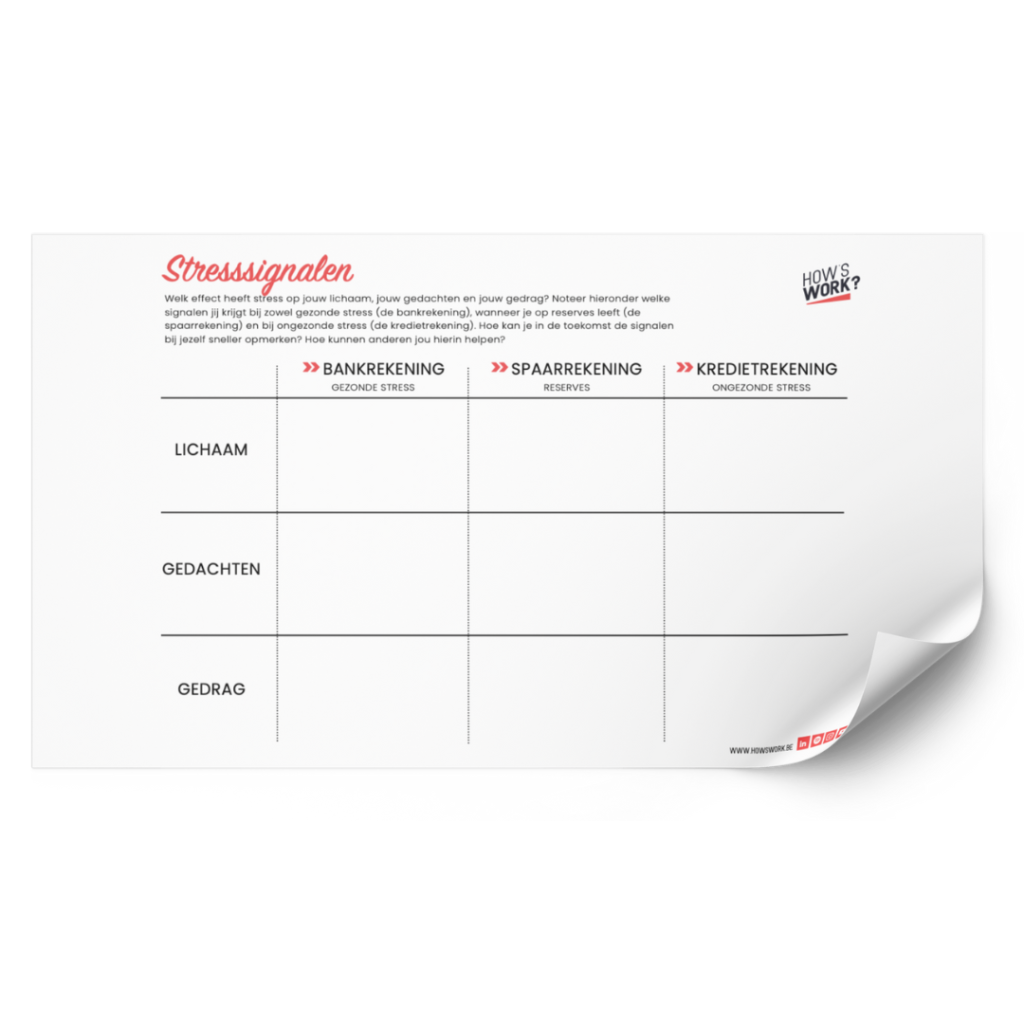
In this exercise, you reflect on your own signals in the different phases of work stress.
Things are changing fast nowadays, especially within organizations. All these changes piling up can really weigh down on our workload. Often resulting in work stress with an impact on our body, but also on how we feel, think, and behave.
We all experience work stress at times when a busy period is approaching. The good news is that our bodies are actually built to deal with stress. Even during longer periods of stress, we can draw from our reserves. And even when these reserves are almost depleted, our body signals that we need to take a rest. Unfortunately, we often overlook these signals from our body. Yet, recognizing these signals is crucial in preventing too much work stress or burnout.
Choose this exercise when you want to increase awareness and knowledge about the impact of insufficient recovery and recognizing the individual stress signals associated with it.
! This exercise can be done individually, during a one-on-one conversation, or together with the whole team.
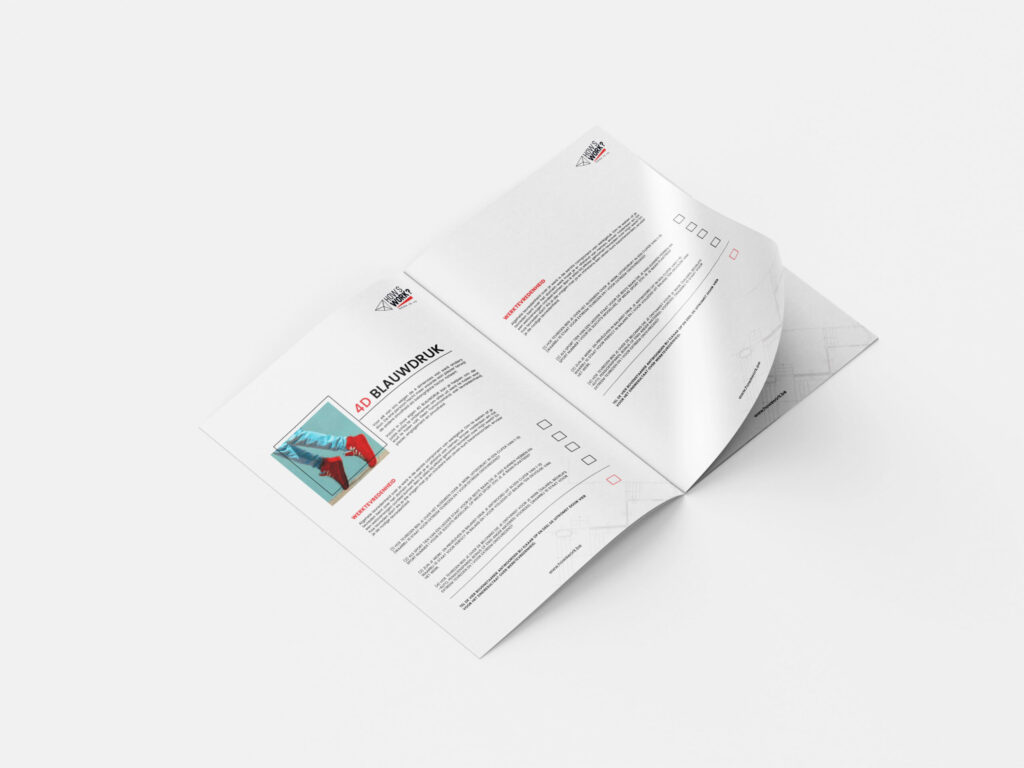
In this exercise, you create a set of rituals for yourself that help you transition from the work context to the personal context.
Endless to-do lists and unexpected situations can leave you with the feeling that work is never really ‘done’, making it difficult to let go of work. However, flipping the switch after work, by maximizing recovery, is crucial. Especially in a time when many of us regularly work and live in the same environment, it has become more challenging to truly disconnect from work.
Choose this exercise when you want to disconnect better after work by paying attention to the transition from work to personal time.
! This exercise can be done individually, during a one-on-one conversation, or together with the whole team.
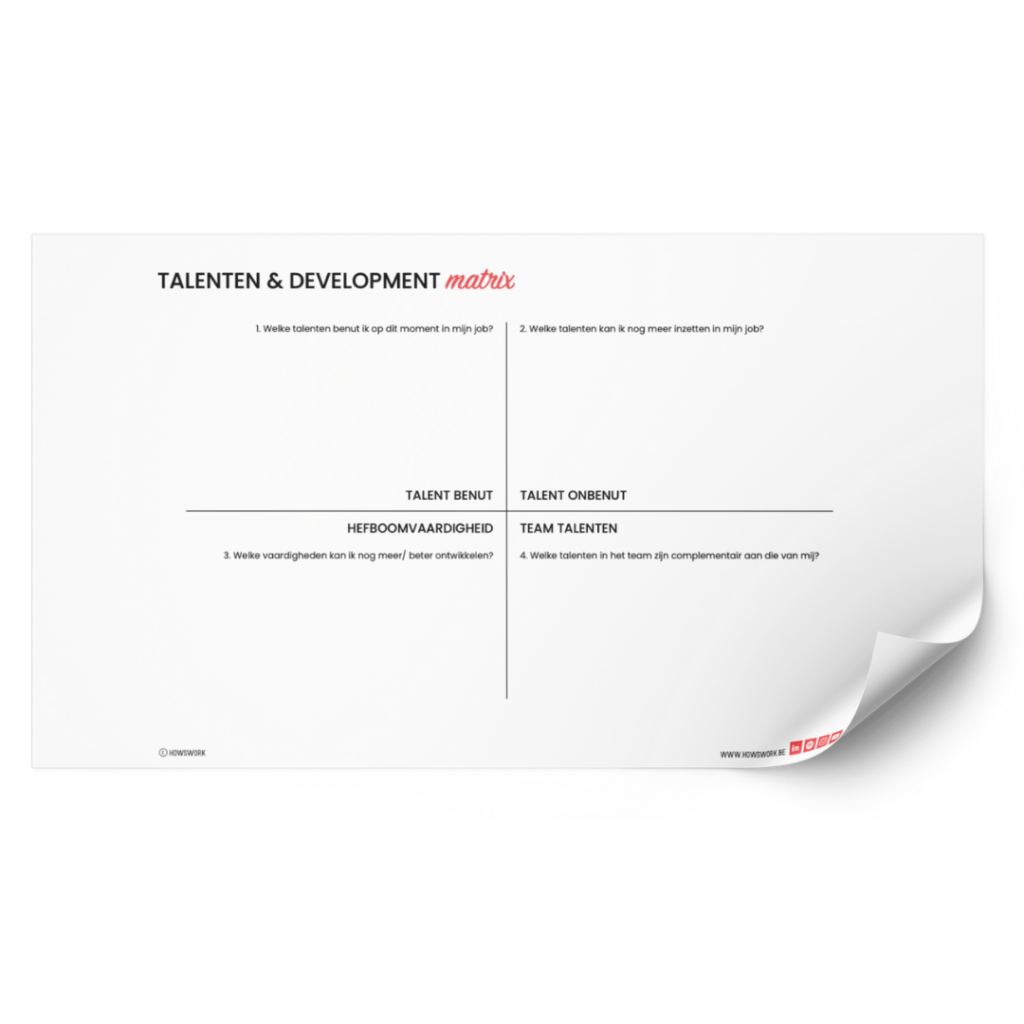
In this exercise, you reflect on the available communication channels and how to use them based on the importance and the urgency of a message.
Digital tools significantly improve our lives. Think about working from home, working in the same document at the same time and communicating without any delay.
However, these digital tools can also create a sense of urgency, making us feel the need to always be available across multiple channels because we might be missing out on important info. This, of course, affects our focus, productivity, and sense of fulfilment at the end of a workday.
Choose this exercise when you want to increase your focus, reduce interruptions, and minimize message overload across different channels.
! This exercise can be done individually, during a one-on-one conversation, or together with the whole team.
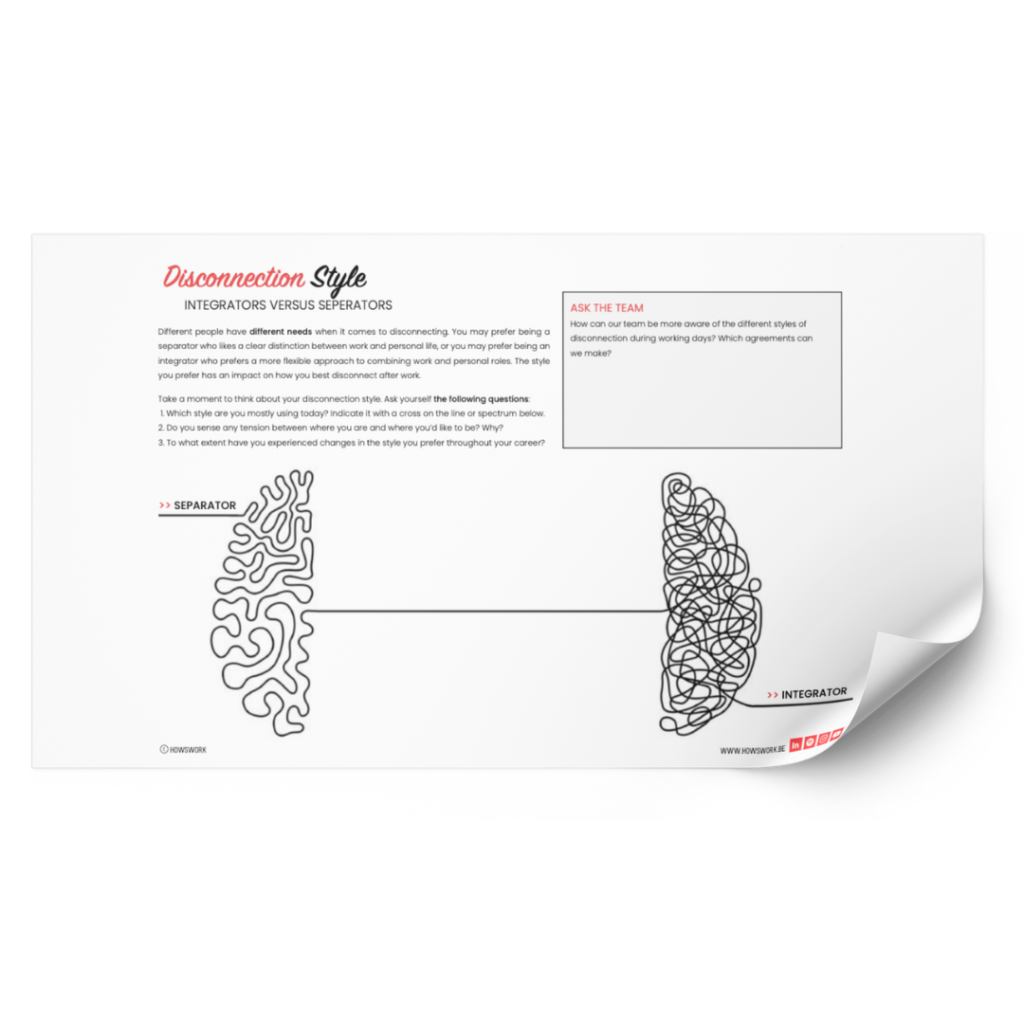
In this exercise, you reflect on your own disconnection style and to talk about your style with the people you work and live with.
Research found that you have 2 types when it comes to combining your work and personal roles. If you are a separator-type you prefer a clearer distinction between work and private life. While an integrator-type prefers a more flexible work-life arrangement where different roles merge. Depending on your style you have other needs in disconnection and will need other techniques to disconnect from time to time.
Choose this exercise when you want to create awareness about the different needs in disconnection. By discussing the disconnection styles within the team, you can collectively take these different needs into account.
! This exercise can be done individually, during a one-on-one conversation, or together with the whole team.